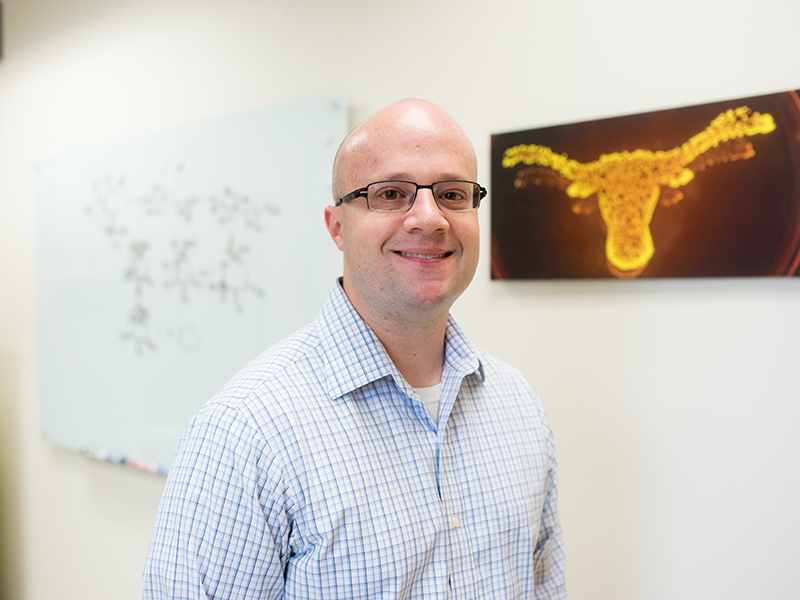
Alper, Hal Ph.D.
Assistant Professor
Chevron Centennial Teaching Fellow in Chemical Engineering

| Office: | CPE 5.408 | Mailing Address: |
| Phone: | (512) 471-4417 | The University of Texas at Austin |
| Fax: | (512) 471-7060 | Department of Chemical Engineering |
| Email: | halper@che.utexas.edu |
200 E Dean Keeton St. Stop C0400 |
| UT Mail: | C0400 | Austin, TX 78712-1589 |
Research Areas: Biotechnology and Energy
Research Group Website
Research Presentation for Prospective Graduate Students
Educational qualifications
Ph.D., Chemical Engineering, Massachusetts Institute of Technology (2006)
B.S., Chemical Engineering, University of Maryland, College Park (2002)
Postdoctoral Research Associate, Whitehead Institute for Biomedical Research (2006-2008)
Postdoctoral Research Associate, Shire Human Genetic Therapies (2007-2008)
Courses Taught
CHE 317 Introduction to Chemical Engineering Analysis
CHE 372 Chemical Reactor Analysis and Design
CHE 185 Graduate Student Seminar Series
UGS 302 Freshman Signature Course: Engineering Biology: Prospects for biofuels to biomedicine
Focus
Biotechnology, Metabolic and Cellular Engineering, Biofuels, Synthetic Biology, and Systems Biology.
Research
The goal of metabolic and cellular engineering is to endow novel and useful properties to cellular systems. Recent advances in molecular biology and genetic engineering empower metabolic engineers with an increasing ability to create any desired cellular modification. The integration of these approaches with an ever-increasing database of knowledge about these cellular systems (due in part to genomic sequencing efforts) provides an unprecedented opportunity to engineer cellular systems. Our research group focuses on the integration and implementation of these tools and knowledge for the design, production, and elicitation of phenotypes relevant to biotechnological processes and medical interest.
Using a variety of host systems including microbial (eg. Eschericia coli), fungal (eg. yeast), and mammalian (eg. Chinese Hamster Ovary (CHO) cells), we seek to develop the necessary genetic tools and methodologies for creating industrially-relevant organisms for biomolecules, biofuels, and biopharmaceuticals. To accomplish this task, traditional pathway engineering will be utilized in conjunction with novel tools for introducing genetic control (such as global Transcription Machinery Engineering, promoter libraries, and gene mutagenesis).
Overall goals:
- To develop new strategies and tools for the engineering and cultivation of cellular systems applicable to both eukaryotic and prokaryotic systems
- To develop suitable host strains (both mammalian and microbial) for the high level production of value-added products and bioactive molecules
- To understand and engineer complex cellular phenotypes, including disease states, in an effort to identify novel genetic targets
- To develop molecular biology tools which allow for both tunable and combinatorial control of gene expression and regulatory networks
- To develop strategies for engineering cellular systems through protein engineering and evolution
Awards & Honors
Office of Naval Research Young Investigator Award (2011)
DuPont Young Professor Award (2010)
Invited Participant, National Academies Keck Futures Initiative Conference, Synthetic Biology: Building on Nature’s Inspiration (2009)
Protégé, The 6th Annual Conference of The Academy of Medicine, Engineering & Science of Texas-attendance based on nomination by National Academy Member (2009)
Texas Exes Teaching Award (2008)
Camille and Henry Dreyfus New Faculty Award (2008)
Merck Student/Young Investigator Poster Award for Best Poster (Metabolic Engineering Conference, 2004)
Selected Publications
- Nathan Crook, Elizabeth Freeman, and Hal Alper, 2011, Re-engineering Multicloning Sites for Function and Convenience, Accepted/In Press, Nucleic Acids Research.
- Eric Young, Ashley Poucher, Austin Comer, Alexandra Bailey, and Hal Alper, 2011, Functional Survey for Heterologous Sugar Transport Proteins using Saccharomyces cerevisiae as a Host, Applied and Environmental Microbiology, 77(10), May 2011.
- Hal Alper and Gregory Stephanopoulos, Engineering microbes for biofuels: Exploiting innate cellular capacity or importing biosynthetic potential?, Nature Reviews Microbiology, 7(10), 715-723, October 2009.
- Hal Alper and Gregory Stephanopoulos, Global transcription machinery engineering: a new approach for improving cellular phenotype, Metabolic Engineering, 9(3), 258-267, May 2007.
- Hal Alper, Joel Moxley, Elke Nevoigt, Gerald Fink, and Gregory Stephanopoulos, Engineering yeast transcription machinery for improved ethanol tolerance and production, Science, 314(5805), 1565 – 1568, December 2006.
- Hal Alper, Curt Fischer, Elke Nevoigt, and Gregory Stephanopoulos, Tuning Genetic Control through Promoter Engineering, PNAS, 102(36), 12678-12683, September 2006.
- Hal Alper, Kohei Miyaoku, and Gregory Stephanopoulos, Construction of lycopene-overproducing E. coli strains by combining systematic and combinatorial gene knockout targets, Nature Biotechnology, 23(5), 612 – 616, May 2005.
- Hal Alper, Yong-su Jin, Joel Moxley, and Gregory Stephanopoulos, Identifying gene targets for the metabolic engineering of Escherichia coli, Metabolic Engineering, 7(3), 155-164, May 2005.