
GeorgeGeorgiou
- gg@che.utexas.edu
- 512-471-6975
- CPE 4.410
Discovery, preclinical and clinical development of protein therapeutics; Vaccine evaluation; Analysis of human immune responses in health and disease
About
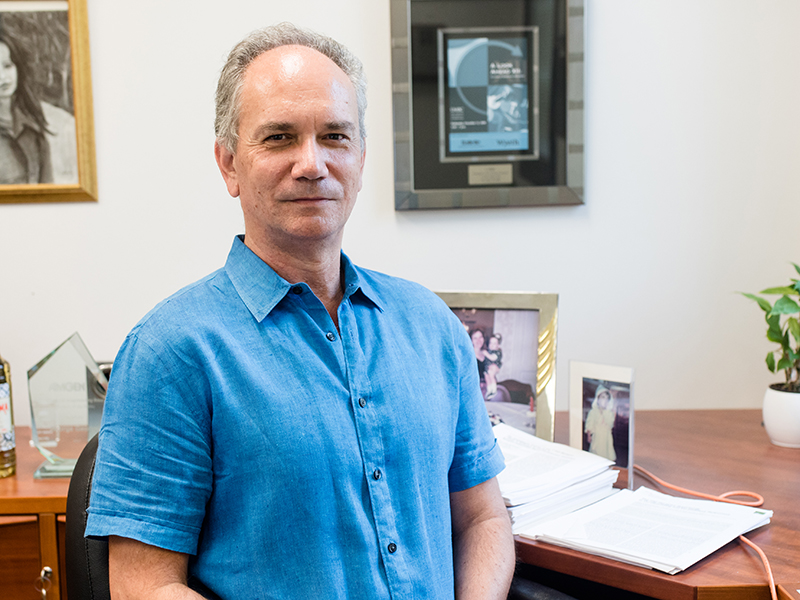
George Georgiou is the Dula D. Cockrell Centennial Chair Professor at UT Austin, where he has served on the faculty continuously since 1986 and currently holds appointments in the Departments of Chemical Engineering, Molecular Biosciences and Biomedical Engineering. He received his B.S. degree in Chemical Engineering from the University of Manchester, UK, and his Ph.D. in Chemical Engineering and in Molecular Biology from Cornell in 1987.
For the first 20 years of his career, he worked on the biogenesis of secreted proteins in bacteria and on protein engineering technologies, but starting in 2007, he shifted his research to human immunology and the discovery and preclinical development of protein therapeutics. Since then, he co-invented and led the early development of 4 protein therapeutics (one approved, three in clinical development), invented methods for the molecular-level analysis of the composition of human serological antibody repertoire, demonstrating among others that the antibody response to infection or vaccination has very restricted clonality and separately, made multiple contributions to antibody effector function biology and Fc engineering.
He has published >280 research papers and is co-inventor of >170 issued and pending US patents, resulting in 28 distinct IP suites that have so far been licensed to 31 pharma & biotech companies. He founded and was president of one company acquired by Maxygen in 2001, and later founded, secured Series A funding and served as Director of two biotech companies that are currently NSDQ listed.
His contributions have been recognized by multiple awards, including the Amgen award in Biochemical Engineering in 2007, his selection as one of “the top 100 eminent chemical engineers of the modern era” by the American Institute of Chemical Engineers (2008) and as a “top 20 translational researcher” by Nature Biotechnology in 2013. He is a member of the US National Academy of Engineering (since 2005), National Academy of Medicine (2011), National Academy of Inventors (2015) and the American Academy of Arts and Sciences (2015).
Educational Qualifications
Ph.D., Chemical Engineering, Cornell University (1987)
M.S., Chemical Engineering, Cornell University (1983)
B.Sc., Chemical Engineering, University of Manchester Institute of Science and Technology (UMIST), England (1981)
Select Awards & Honors
- William H. Walker Award for Excellence in Contributions to Chemical Engineering Literature – American Institute of Chemical Engineers (2019)
- Billy & Claude R. Hocott Distinguished Centennial Engineering Research Award – The University of Texas at Austin (2018-2019)
- National Academy of Inventors member (2015)
- American Academy of Arts and Sciences (AAAS) fellow (2015)
- Inventor of the Year – The University of Texas at Austin (2014)
- National Academy of Medicine member (NAM) (2011)
- Named one of “100 Eminent Chemical Engineers of the Modern Era” – American Institute of Chemical Engineers (2008)
- National Academy of Engineering member (NAE) (2005)
- American Institute for Medical and Biological Engineering member (AIMBE) (1996)
- Presidential Young Investigator Award – National Science Foundation (1987)
Related Websites
- Georgiou Research Group
- Molecular Biosciences + Interdisciplinary Life Sciences Graduate Programs, John Ring LaMontagne Center for Infectious Disease
- Texas Biologics
- Texas Materials Institute